

You’ve decided to implement AI. You’ve invested in training. You’re ready for transformation.
Then reality hits: Your team resists.
AI adoption challenges in Malaysia are real. It’s not technical problems stopping AI implementation. It’s people problems.
Malaysian companies report the same pattern: 20-30% embrace AI immediately, 40-50% are cautiously open, and 20-30% actively resist. That resistant minority can derail your entire AI adoption initiative.
But AI resistance in Malaysian workplaces isn’t inevitable. It’s predictable. Which means it’s solvable.
Companies successfully overcoming AI adoption challenges in Malaysia follow specific patterns. Here’s the complete playbook.
Why Malaysian Employees Resist AI (The Real Reasons)
Understanding AI adoption challenges Malaysia requires understanding the fears driving resistance.
Fear #1: “AI will replace my job”
The biggest AI resistance in Malaysian workplaces stems from job security fears. Employees see headlines about AI automation. They worry.
In Malaysia’s relationship-based work culture, losing your job isn’t just losing income. It’s losing face, disappointing family, threatening stability.
This fear is real even when unfounded. Your reassurance alone won’t solve AI adoption challenges Malaysia.
Fear #2: “I’m too old/not technical enough”
Malaysian workplaces span age ranges from 20s to 60s. Older employees often feel AI adoption challenges are insurmountable.
“I can barely use Excel. How will I use AI?”
This creates AI resistance before they even try.
Fear #3: “This is just another management trend”
Cynical employees have seen many initiatives come and go. Quality circles. Six Sigma. Lean. Digital transformation.
They view AI adoption as this year’s buzzword. Wait it out, management will move on.
This cynicism creates passive AI resistance in Malaysian workplaces. They don’t openly oppose. They just don’t engage.
Fear #4: “I’ll look stupid if I make mistakes”
Malaysian culture values face-saving. Making mistakes publicly, especially with new technology, causes embarrassment.
Fear of looking incompetent drives AI resistance more than actual inability.
Fear #5: “My expertise becomes worthless”
Employees who spent 10-20 years building expertise fear AI makes it obsolete.
“If AI can do what I do, what’s my value?”
This existential AI adoption challenge in Malaysia is deeply personal.
The 5 Types of AI Resistors in Malaysian Companies
AI resistance in Malaysian workplaces takes different forms. Identify which type you’re dealing with:
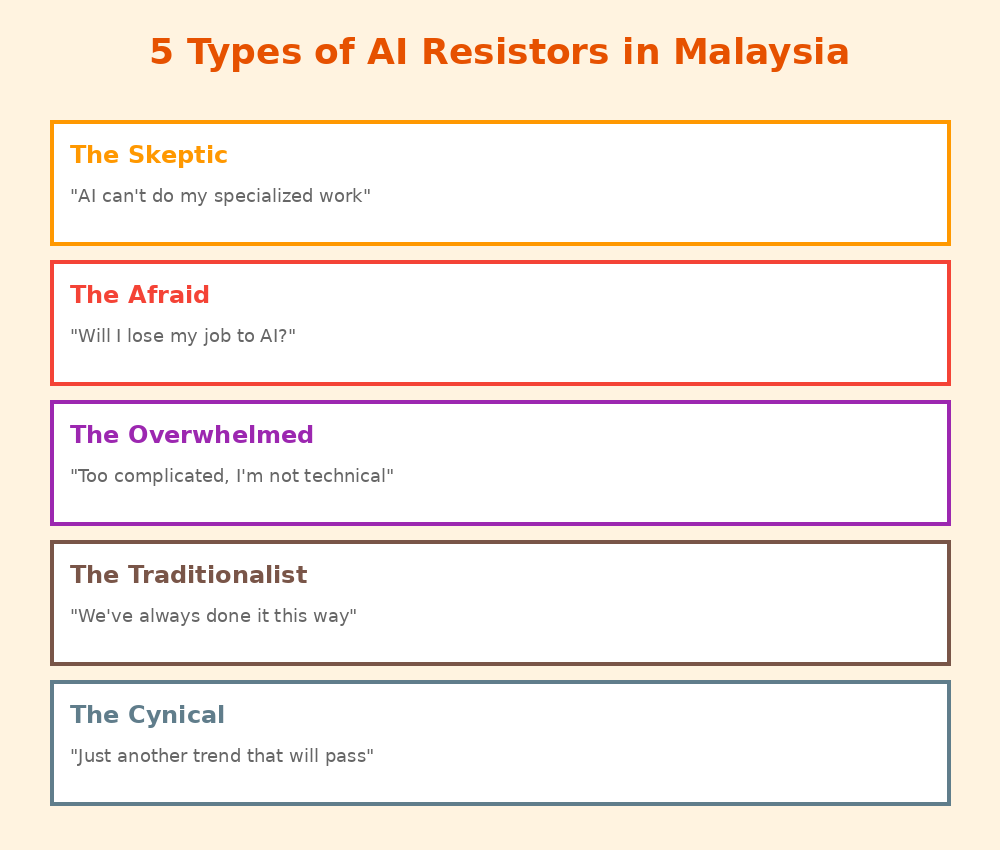
The Skeptic: “AI can’t do my specialized work”
Believes their work is too complex/nuanced for AI. Often right about AI limitations but wrong about AI augmentation value.
Common in: Professional services, creative roles, senior positions
How to overcome this AI resistance: Show specific use cases, not general capabilities. Demonstrate AI handling 80% of routine work, freeing them for 20% high-value work.
The Afraid: “Will I lose my job to AI?”
Genuinely worried about job security. May be sole breadwinner. Feels AI adoption threatens livelihood.
Common in: Administrative roles, junior positions, operational functions
How to address this AI adoption challenges Malaysia: Direct reassurance from leadership. Show AI creating new roles, not eliminating existing ones. Provide AI training to make them valuable, not obsolete.
The Overwhelmed: “Too complicated, I’m not technical”
Intimidated by perceived complexity. Assumes AI adoption requires programming or technical skills.
Common in: Non-technical departments, older employees, those with limited tech exposure
How to overcome this AI resistance in Malaysia: Start with simplest use cases. Provide extra support. Celebrate small wins. Show it’s easier than they think.
The Traditionalist: “We’ve always done it this way”
Values proven methods. Sees AI adoption as unnecessary change. Often tenured employees with influence.
Common in: Long-serving staff, senior roles, conservative industries
How to address this AI adoption challenges Malaysia: Respect their expertise. Frame AI as tool to do familiar tasks better, not replacement of familiar methods. Get their input on AI implementation.
The Cynical: “Just another trend that will pass”
Has seen many initiatives fail. Doesn’t believe AI adoption will stick. Waits for management to lose interest.
Common in: Middle management, employees who’ve survived previous failed initiatives
How to overcome this AI resistance: Demonstrate leadership commitment. Show concrete results fast. Make AI adoption irreversible through embedded processes.
Each AI adoption challenge in Malaysia requires different approach. One-size-fits-all fails.
10 Proven Strategies to Overcome AI Resistance
These strategies work across Malaysian companies successfully tackling AI adoption challenges Malaysia:
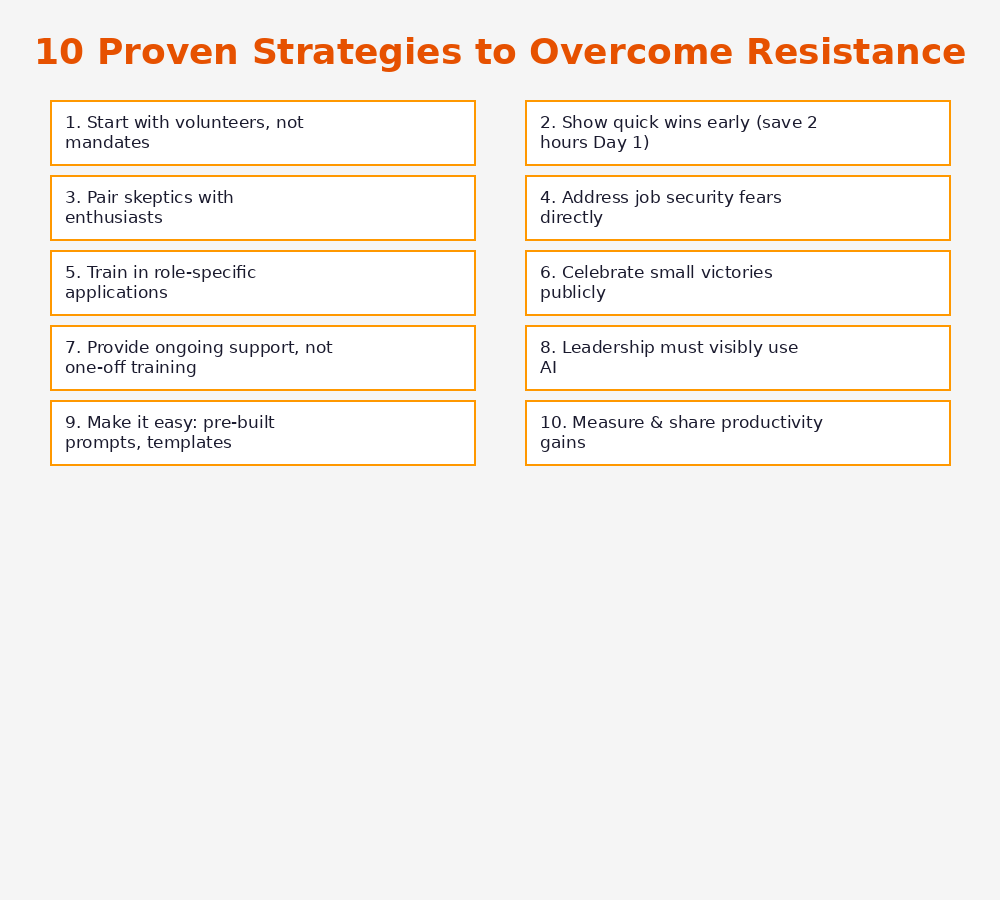
Strategy 1: Start with Volunteers, Not Mandates
Forcing AI adoption creates resistance. Inviting volunteers creates champions.
Malaysian implementation: “We’re piloting AI tools. Looking for 5-10 volunteers. You’ll get priority training and support. Help shape how we use AI company-wide.”
This overcomes AI resistance by making it optional and prestigious initially.
Strategy 2: Show Quick Wins Early
Nothing overcomes AI adoption challenges like visible success.
Target: Save volunteers 2-3 hours in first week. Make wins obvious and shareable.
“Ahmad used AI to draft client proposal in 30 minutes instead of 3 hours. Here’s how.”
Quick wins convert skeptics into AI adoption advocates.
Strategy 3: Pair Skeptics with Enthusiasts
Malaysian workplace culture values relationships. Use it to overcome AI resistance.
Pair resistant employees with AI-enthusiastic colleagues. Not as teacher-student. As co-learners exploring together.
Relationship trust reduces AI adoption challenges Malaysia.
Strategy 4: Address Job Security Fears Directly
Don’t avoid the elephant. Tackle AI resistance head-on.
Town hall from CEO: “AI won’t eliminate jobs here. It’ll eliminate boring tasks. We’re investing in training everyone on AI. Your job is to use AI, not be replaced by it. Companies that don’t adopt AI will struggle. Our choice: Lead with AI or follow without jobs.”
Clear messaging reduces AI adoption challenges from uncertainty.
Strategy 5: Make Training Role-Specific
Generic AI training creates resistance. Specific applications create adoption.
Don’t train everyone on “AI basics.” Train HR on AI for HR, sales on AI for sales, operations on AI for operations.
Relevance overcomes AI resistance faster than general knowledge.
Strategy 6: Celebrate Small Victories Publicly
Malaysian culture responds well to public recognition. Use it to drive AI adoption.
Weekly email: “This Week’s AI Win: Siti saved 4 hours using AI for report analysis. Department productivity up 15%.”
Public celebration converts fence-sitters, reduces AI adoption challenges.
Strategy 7: Provide Ongoing Support
One-off training creates AI resistance when people struggle alone after.
Establish support system:
- AI champions available for questions
- Weekly office hours
- Shared prompt library
- Internal community group
Support infrastructure overcomes AI adoption challenges Malaysia at implementation stage.
Strategy 8: Leadership Must Visibly Use AI
If CEO doesn’t use AI, team won’t either. Malaysian workplace culture follows leadership.
CEO in meetings: “I used AI to prepare this analysis…” Manager emails: “AI helped me draft this…” Director presents: “AI identified this trend…”
Visible leadership usage eliminates “wait and see” AI resistance.
Strategy 9: Make AI Easy
Reduce barriers to overcome AI adoption challenges Malaysia:
- Pre-built prompt templates
- One-click tools
- Simple interfaces
- Clear instructions in Bahasa/English/Chinese
Friction creates AI resistance. Ease creates adoption.
Strategy 10: Measure and Share Productivity Gains
Numbers overcome AI resistance better than words.
Monthly dashboard:
- Team AI adoption rate: 67%
- Average time saved per user: 8.5 hours/week
- Projects completed faster: 12
- Client satisfaction improvement: +15%
Data proves AI adoption works, reducing resistance from skeptics.
The 90-Day AI Adoption Roadmap for Malaysian Companies
Systematic approach overcomes AI adoption challenges Malaysia better than ad-hoc efforts:
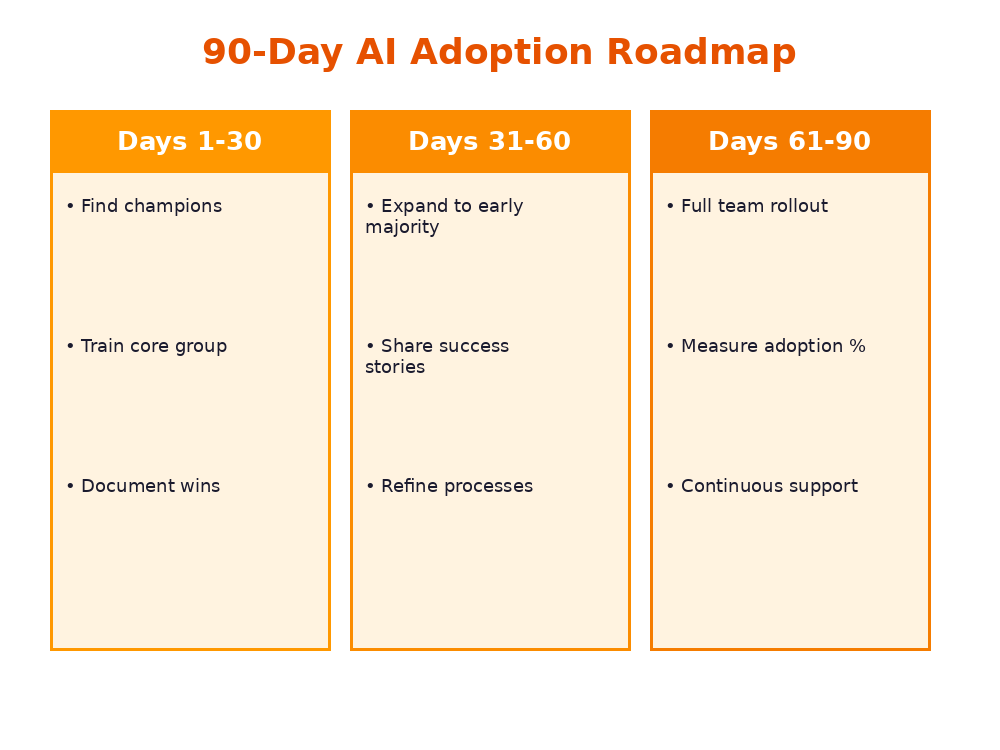
Days 1-30: Foundation and Champions
Week 1: Leadership Alignment
Get executive team committed to overcoming AI adoption challenges:
- Present business case with ROI calculations
- Agree on AI adoption goals
- Commit to visible AI usage
- Allocate budget for training
Week 2: Identify Champions
Find 8-12 employees who’ll drive AI adoption:
- Tech-savvy but not IT department
- Respected by peers
- Cross-functional representation
- Enthusiastic volunteers
Week 3: Train Champions
Intensive training for champions to overcome their AI adoption challenges first:
- Tool proficiency (ChatGPT, Claude, prompt engineering)
- Role-specific applications
- How to support others
- Change management basics
Use HRD Corp certified training so it costs RM0.
Week 4: Document Quick Wins
Champions use AI for real work, document results:
- What task?
- Time before AI vs with AI?
- Quality comparison?
- Screenshots/examples?
Build case study library showing AI adoption success.
Days 31-60: Early Majority Engagement
Week 5: Company-Wide Announcement
CEO announces AI adoption initiative:
- Why we’re doing this (competitive necessity)
- What’s in it for employees (skill development, easier work)
- Training plan (everyone gets trained)
- Support available (champions, resources)
- Success stories from champions
Clear communication reduces AI resistance from uncertainty.
Week 6-7: Department-by-Department Training
Roll out training by department to manage AI adoption challenges:
- 2-hour workshop per department
- Role-specific use cases
- Hands-on practice
- Champion present to provide support
Week 8: Success Story Campaign
Amplify wins to overcome AI resistance:
- Email newsletter featuring users
- Internal social media posts
- Lunch-and-learn sessions
- Recognition in team meetings
Days 61-90: Full Adoption and Optimization
Week 9: Mandatory Adoption
After 60 days of voluntary adoption, make it standard:
- AI usage becomes performance expectation
- Managers check team adoption in 1-on-1s
- Extra support for struggling users
- Celebrate hitting team adoption targets
Week 10: Process Integration
Embed AI in workflows to overcome passive AI resistance:
- Update SOPs to include AI steps
- Templates include AI-generated sections
- Quality checks assume AI assistance
- Timelines reflect AI-enabled speed
Week 11: Measure Results
Quantify AI adoption impact:
- Productivity metrics (time saved, output increased)
- Quality metrics (error rates, client satisfaction)
- Adoption metrics (usage rate, competency level)
- Financial metrics (cost savings, revenue impact)
Week 12: Plan Next Phase
Build on success addressing AI adoption challenges:
- Advanced training for power users
- New use cases to explore
- Tools to add
- Departments to expand into
By day 90, AI adoption is normal. AI resistance is minimal. Team operates at new productivity level.
Malaysian Culture Considerations for AI Adoption
AI adoption challenges in Malaysia require understanding local workplace culture:
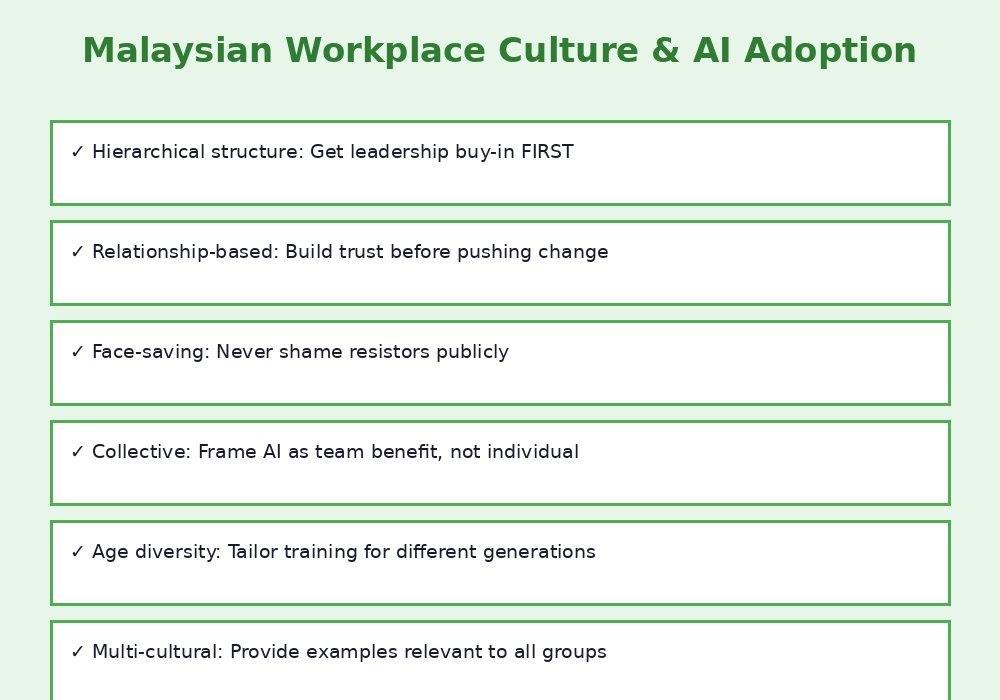
Hierarchical Structure
Malaysian workplaces respect hierarchy. Use it to overcome AI resistance.
If CEO champions AI adoption, team follows. If middle managers resist, team resists.
Strategy: Get leadership commitment first. Public endorsement from top reduces AI adoption challenges.
Relationship-Based Culture
Malaysians trust people before processes. Build relationships to drive AI adoption.
Don’t mandate AI usage from HR department nobody knows. Have respected managers, beloved colleagues champion it.
Strategy: Identify influential employees (formal and informal leaders). Win them over. They’ll influence others.
Face-Saving Importance
Public failure causes embarrassment in Malaysian culture. This creates AI resistance.
Don’t call out resistors publicly. Don’t shame poor performers. Provide private support.
Strategy: Celebrate successes publicly. Address struggles privately. Create safe learning environment.
Collective vs Individual
Malaysian culture values team over individual. Frame AI adoption as team benefit.
Wrong: “AI makes you individually more productive”
Right: “AI helps our team serve clients better, making whole company stronger”
Strategy: Emphasize collective benefits to reduce AI adoption challenges.
Age Diversity
Malaysian workplaces span generations. Each faces different AI resistance factors.
Gen Z: Needs minimal convincing, may lack business context
Millennials: Tech-comfortable, worried about job security
Gen X: Skeptical of trends, values proven methods
Boomers: Intimidated by technology, rich experience
Strategy: Tailor messaging and support by generation to overcome specific AI adoption challenges each faces.
Multi-Cultural Workplace
Malaysian companies include Malay, Chinese, Indian, and expatriate employees.
Provide training materials in multiple languages. Use examples relevant to all groups. Respect cultural sensitivities.
Strategy: Inclusive approach reduces AI resistance from any group feeling excluded.
How to Measure AI Adoption Success
Track these metrics to know if you’re overcoming AI adoption challenges Malaysia:
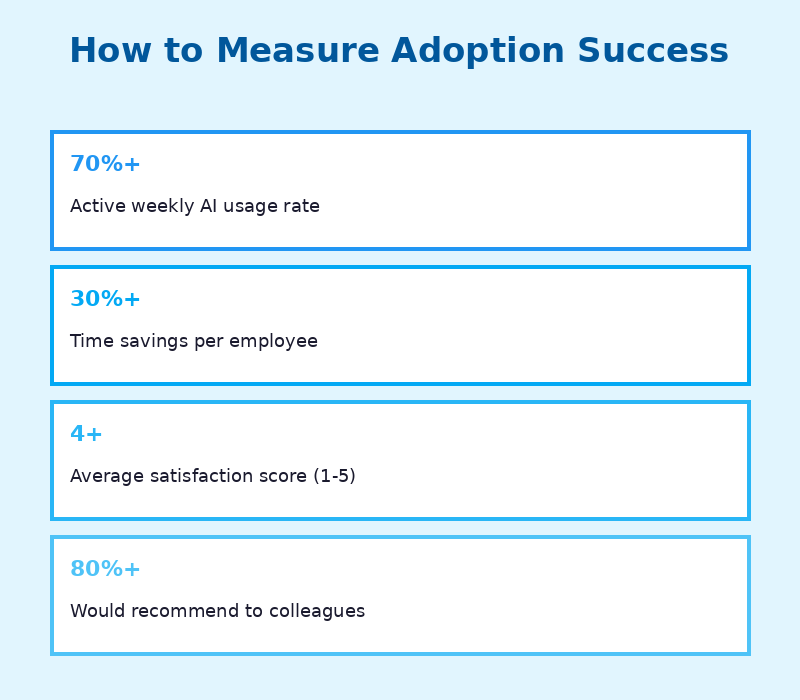
Usage Rate: Target 70%+
Percentage of employees actively using AI tools weekly.
Below 50%: AI resistance still high, adoption struggling
50-70%: Moderate success, some resistance remains
70%+: Strong adoption, resistance overcome
Time Savings: Target 30%+
Average time saved per employee on AI-assisted tasks.
Survey monthly: “Compared to before AI tools, how much time do you save weekly?”
10-20%: Some impact
20-30%: Good impact
30%+: Excellent impact, AI adoption succeeding
Satisfaction: Target 4+ out of 5
“How satisfied are you with AI tools for your work?”
Below 3: AI resistance remains, tools not helpful
3-4: Moderate satisfaction
4+: High satisfaction, resistance overcome
Advocacy: Target 80%+
“Would you recommend AI tools to colleagues?”
High advocacy = Low resistance = Successful AI adoption
Track monthly to catch AI adoption challenges early.
Real Malaysian Company AI Adoption Success Stories
Professional Services Firm (85 employees):
Initial AI resistance: 40% actively opposed, citing “our work is too specialized”
Approach: Started with 10 volunteers. Documented 3-hour proposal writing becoming 45 minutes. Showed senior partners using AI. Paired skeptics with enthusiasts.
Results after 90 days: 78% adoption rate, 35% average time savings, AI resistance eliminated except 3 employees (who eventually adopted seeing peer success).
Manufacturing Company (200 employees):
Initial AI adoption challenges: Older workforce (average age 45), minimal tech exposure, “we make physical products, AI is for tech companies” resistance.
Approach: Extra patient training. Started with simplest use cases (email writing, report generation). Production managers visibly used AI. Celebrated every small win.
Results: 6 months to reach 65% adoption (slower than typical), but 40% productivity improvement in administrative tasks. Overcome AI resistance through patience and support.
Retail Business (50 employees):
Initial resistance: “Too busy to learn new tools” from frontline staff.
Approach: Trained management first. Managers used AI to reduce admin burden on frontline. Staff saw more time for customers. Then offered AI training as time-saver, not additional work.
Results: 82% adoption in 60 days. AI resistance turned to enthusiasm when positioned as help, not work.
Common pattern: Companies overcoming AI adoption challenges Malaysia start small, show wins, build momentum systematically.
When to Bring in Outside Help
Some AI adoption challenges require external expertise:
Bring in expert trainers when:
- Internal AI knowledge is limited
- Resistance is widespread (50%+ opposing)
- Previous attempts failed
- Need industry-specific guidance
- Want structured program not ad-hoc learning
External trainers overcome AI resistance Malaysia by:
- Bringing fresh perspective (not “management’s latest idea”)
- Showing industry examples (proof it works)
- Providing professional training (confidence-building)
- Offering ongoing support (reducing fear of failure)
Companies investing in professional AI training overcome adoption challenges 3x faster than those trying DIY approach.
Your AI Adoption Action Plan
This week: Identify your resistor types. Who’s skeptical? Afraid? Overwhelmed? Traditionalist? Cynical? Understand their specific AI resistance.
This month: Find 8-12 champions. Get them trained properly. Document their quick wins. Build momentum.
This quarter: Execute 90-day roadmap. Train department-by-department. Address AI adoption challenges Malaysia systematically, not randomly.
This year: Achieve 70%+ adoption. Embed AI in workflows. Make it normal, not special.
AI resistance in Malaysian workplaces is real. But it’s not insurmountable. Companies that approach AI adoption challenges systematically succeed. Those that don’t, struggle.
The difference isn’t technology. It’s change management.
Need help overcoming AI resistance in your Malaysian company?
I’m David Hooi, HRD Corp Accredited Trainer with 20+ years corporate change management experience. I’ve helped Malaysian companies overcome AI adoption challenges through proven methodologies.
Our AI Adoption Program tackles resistance directly:
- ✓ HRD Corp certified – Training costs 100% reimbursed
- ✓ Change management focus – Not just technical training
- ✓ Malaysian culture expertise – Understand local workplace dynamics
- ✓ Champion development – Train internal advocates
- ✓ 90-day roadmap – Systematic adoption, not hope and pray
- ✓ Ongoing support – Address resistance as it emerges
We’ve successfully overcome AI adoption challenges at TNB, Great Eastern, RHB, and 180+ Malaysian companies.
Free consultation includes:
- AI resistance assessment for your company
- Customized 90-day adoption roadmap
- Champion identification strategy
- Culture-specific recommendations
- Expected adoption timeline and metrics
Book Free AI Adoption Strategy Call
Stop fighting AI resistance. Start systematically overcoming it.