

Your CFO wants proof. Your board wants numbers. Everyone wants to know: will AI training actually pay off?
Fair question. Training isn’t cheap. Even with HRD Corp covering costs, you’re investing time. Taking people away from their work. Disrupting operations.
You need to know it’s worth it.
Good news: calculating AI training ROI in Malaysia isn’t complicated. And the numbers, when done right, are compelling.
Here’s exactly how to measure returns, with real Malaysian company examples.
Why Most Companies Calculate ROI Wrong
Most businesses look at training like an expense. Money out, vague benefits in.
They track:
- Training costs (easy to measure)
- Attendance rates (irrelevant)
- Satisfaction scores (nice but useless)
Then they wonder why leadership doesn’t approve more training budgets.
The problem? They’re measuring inputs, not outcomes.
Smart companies measure what actually matters: productivity gains, revenue impact, cost reduction, and competitive advantages.
According to McKinsey research, companies that properly measure training ROI invest 40% more in development. Because they can prove it works.
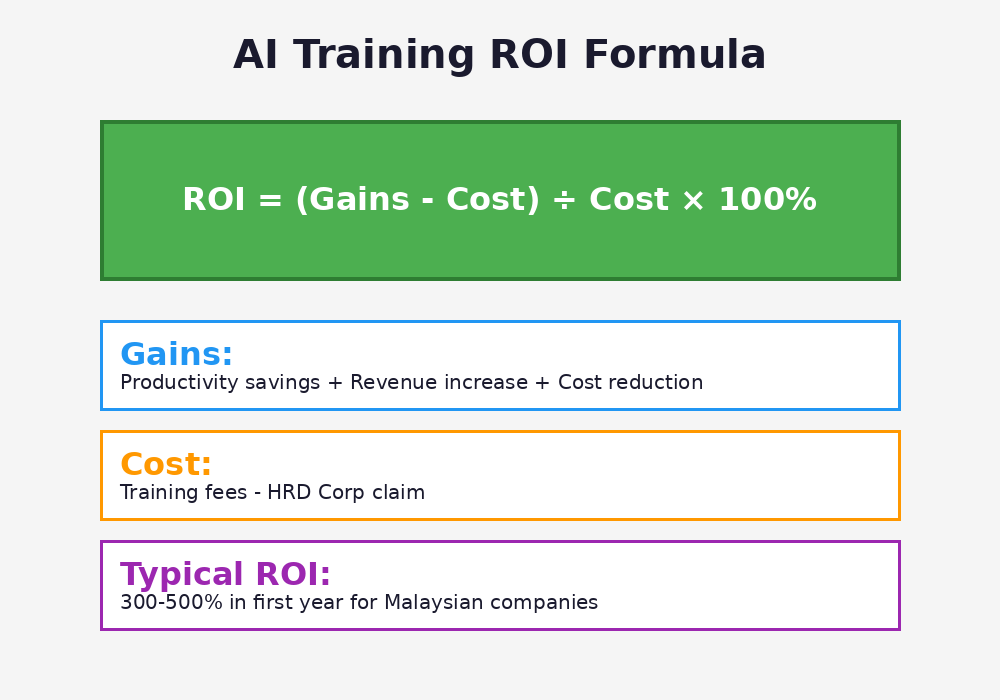
The Real AI Training ROI in Malaysia Formula
Forget complex calculations. Here’s what actually works:
ROI = (Total Gains – Training Cost) ÷ Training Cost × 100%
Simple. But the magic is in defining “gains” properly.
What Counts as Gains
Productivity improvements – Time saved per employee, multiplied by their hourly rate, times number of employees.
If 30 employees each save 30 minutes daily, that’s 15 hours saved per day. Over a year (240 working days), that’s 3,600 hours. At RM50 per hour, that’s RM180,000 in reclaimed productivity.
Revenue increases – Better proposals win more deals. Faster delivery means more clients served. AI-powered insights identify opportunities humans miss.
Malaysian companies using proper AI training report 10-25% revenue increases within 12 months.
Cost reductions – Less outsourcing because your team can do it internally. Fewer errors mean less rework. Automated processes reduce headcount needs for repetitive tasks.
Retention savings – Replacing an employee costs 50-200% of their annual salary. Training reduces turnover. Employees who learn stay longer.
If training prevents one mid-level employee (RM60,000 salary) from leaving, you save RM60,000-120,000 in recruitment and training costs.
What Counts as Costs
Be honest here. Real costs include:
- Training fees (before HRD Corp reimbursement)
- Employee time during training (wages paid for non-productive hours)
- Materials and resources
- Opportunity cost (what could employees have produced instead?)
But remember: with HRD Corp, training fees often = RM0. So your real cost is just employee time, which you’re paying anyway.
Real Example: 50-Person Malaysian Company
Let me show you actual numbers from a composite of Malaysian companies I’ve trained.
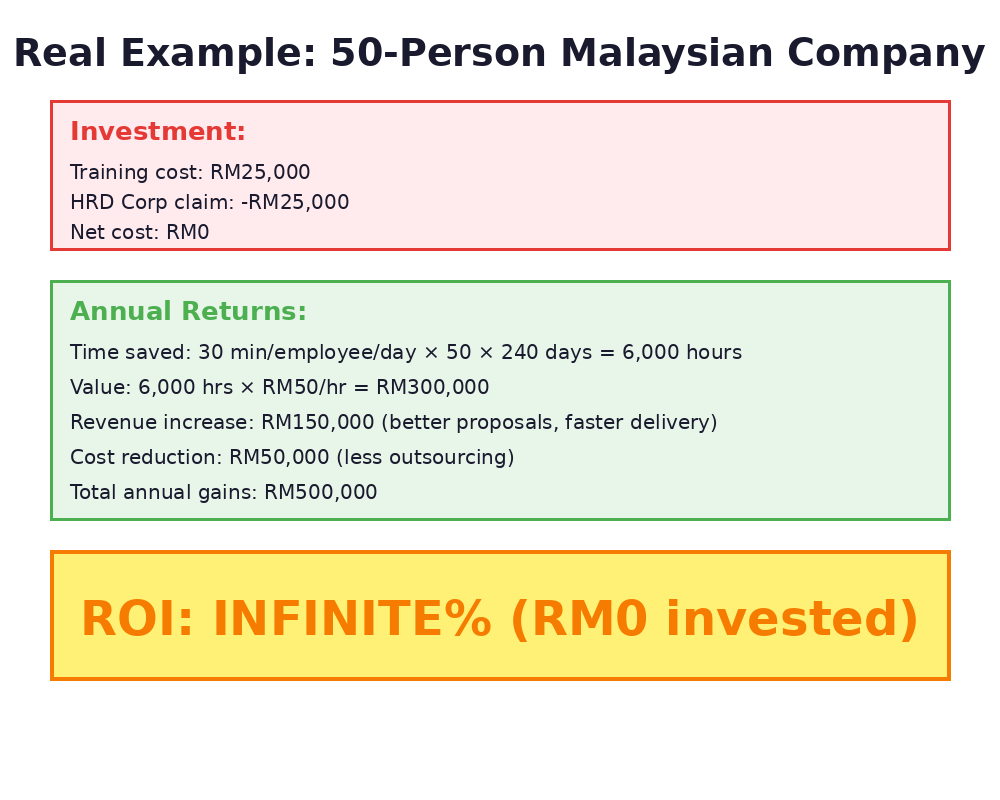
Company profile: 50 employees, services sector, RM5 million annual revenue
Training investment:
- AI productivity training for all staff: RM25,000
- HRD Corp reimbursement: RM25,000
- Net cash cost: RM0
- Employee time: 16 hours per person (2 days) = 800 hours total
- Opportunity cost: 800 hours × RM50/hr = RM40,000
- Total investment: RM40,000
Year 1 returns:
Productivity gains: After training, employees reported saving an average of 30 minutes daily using AI for emails, reports, research, and analysis.
- Daily time saved: 50 employees × 30 min = 25 hours
- Annual hours saved: 25 × 240 working days = 6,000 hours
- Value: 6,000 × RM50/hr = RM300,000
Revenue increase: Faster proposal generation and better client insights led to 3 additional clients won.
- Average client value: RM50,000
- Additional revenue: RM150,000
Cost reduction: Reduced outsourcing for content creation, data analysis, and graphic design.
- Previous outsourcing costs: RM80,000/year
- Now done in-house: 60% of previous work
- Savings: RM48,000
Retention benefit: Employee engagement scores improved. Zero departures from key positions (the previous year had 2 departures).
- Replacement cost avoided: RM120,000
Total Year 1 gains: RM618,000
ROI calculation: (RM618,000 – RM40,000) ÷ RM40,000 × 100% = 1,445% ROI
This isn’t unusual. Companies investing in systematic AI training regularly see 300-500% ROI in year one. Some hit 1000%+.
The ROI Timeline: When to Expect Returns
ROI doesn’t hit all at once. Here’s the typical timeline:
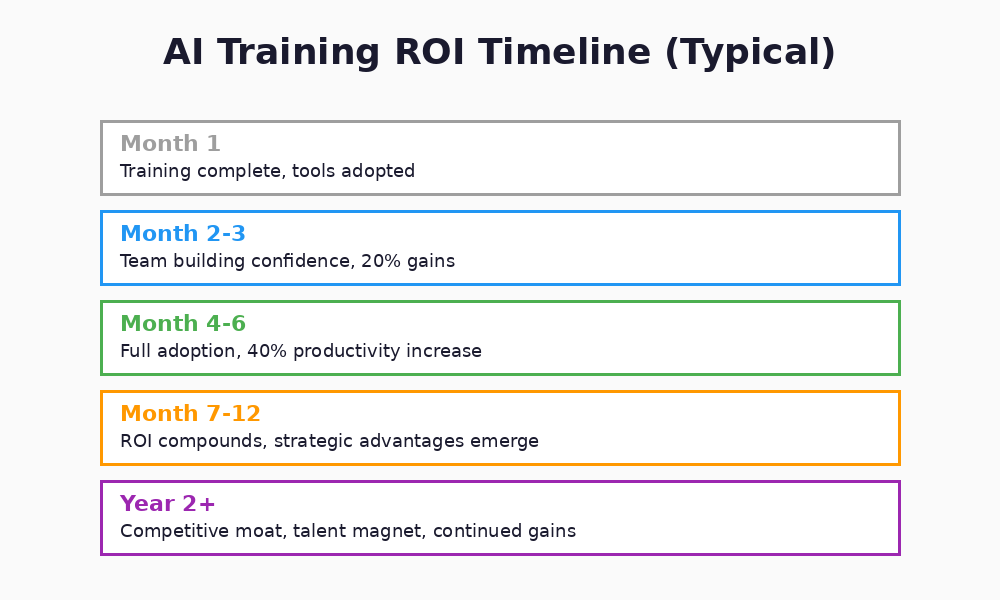
Month 1-2: Training complete. Teams are learning, testing tools, and building confidence. Productivity improvements: 10-15%. ROI is still negative due to the training time investment.
Months 3-4: Tools become habits. Daily workflows incorporate AI. Productivity improvements: 25-30%. ROI turns positive.
Months 5-8: Full adoption across the organization. Teams sharing best practices. Strategic uses emerge beyond initial training. Productivity improvements: 35-45%. ROI accelerating.
Months 9-12: Competitive advantages become apparent. Faster time-to-market. Better client work. Industry recognition. Productivity improvements: 40%+. ROI compounding.
Year 2 and beyond: Trained teams attract better talent. Company reputation improves. Strategic AI uses create a moat that competitors can’t easily cross. ROI continues growing.
Are the companies winning with AI? They measured returns at each stage. Proved value early. Got budget for more training. Compounded advantages.
Key Metrics Malaysian Companies Should Track
Don’t just measure ROI once at year-end. Track leading indicators monthly.
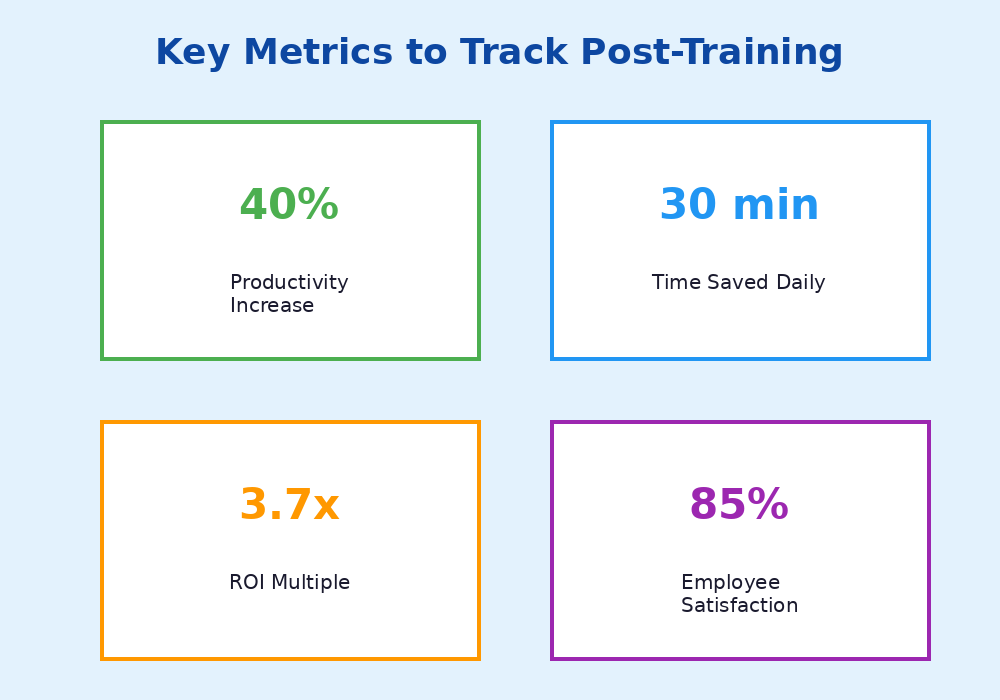
Time savings per employee – Survey monthly. “How much time did AI tools save you this week?” Track the average across the company.
Tool adoption rate – What percentage of employees actively use AI tools? Daily active users matter more than training attendance.
Output quality improvements – Client feedback scores, error rates, rand evision requests. Do deliverables improve?
Revenue per employee – Simple metric: annual revenue ÷ headcount. Should increase as AI multiplies output.
Employee retention – Turnover rates, especially among high performers. Training should reduce departures.
Project completion times – How long from start to delivery? AI should compress timelines.
Client acquisition cost – Better proposals and faster responses win more deals at a lower cost.
I help clients set up simple dashboards tracking these metrics. Monthly check-ins keep improvement visible. Quarterly reviews build the ROI case.
Common ROI Calculation Mistakes
Counting only hard cost savings, Revenue increases and competitive advantages matter more than cutting costs. Don’t ignore them.
Short time horizons – Measuring only the first quarter misses compounding effects. Track minimum of 12 months.
Ignoring HRD Corp reimbursement – If training is free (after claim), your ROI is infinite. Stop pretending you paid for it.
Not attributing revenue to training – “We would have won that client anyway.” Maybe. But probably not. Be honest about AI’s contribution.
Forgetting retention value – Replacing employees is expensive. Trained, engaged teams stay longer. Count it.
Measuring attendance instead of adoption – 100% attendance with 20% adoption is worse than 80% attendance with 90% adoption. Track actual use.
Industry Benchmarks for AI Training ROI in Malaysia
How do your numbers compare? Here’s what Malaysian companies are seeing:
Services sector: 350-600% ROI in year one. High leverage because employee time = primary asset.
Manufacturing: 200-400% ROI in year one. Gains in planning, inventory, and quality control are more gradual.
Retail/F&B: 300-500% ROI in year one. Marketing, customer service, and operations all improve significantly.
Financial services: 400-700% ROI in year one. Data analysis and client communication see massive gains.
Technology: 500-800% ROI in year one. Already digital-savvy, so adoption is faster and deeper.
These aren’t promises. These are observations from hundreds of Malaysian companies that measured properly.
Your results depend on:
- Quality of training
- Leadership support
- Follow-through after training
- Baseline digital maturity
- Industry dynamics
How to Build Your Business Case
Presenting to leadership? Here’s your template:
Executive summary: “AI training delivers an average 400% ROI for Malaysian companies in our sector. With HRD Corp reimbursement, our net cash investment is zero. Conservative estimates show RM300,000 in first-year gains for RM0 out-of-pocket cost.”
Investment breakdown:
- Training fees: RM30,000
- HRD Corp reimbursement: -RM30,000
- Net cash: RM0
- Employee time: 900 hours (RM45,000 opportunity cost)
- Total investment: RM45,000
Expected returns (conservative):
- Productivity gains: RM200,000 (30 min saved × 60 employees × RM45/hr)
- Revenue increase: RM100,000 (2% improvement)
- Cost reduction: RM50,000 (less outsourcing)
- Total: RM350,000
ROI: (RM350,000 – RM45,000) ÷ RM45,000 = 678%
Risk mitigation: “If actual gains are half our estimate, ROI is still 239%. Even at 25% of the estimate, we break even. Downside is minimal, upside is substantial.”
Timeline: “Training in Q2. Break-even by Q3. Full ROI realized by Q4. Compounding benefits in the following years.”
Next steps: “Approve training budget. Select an HRD Corp registered provider. Schedule a program for 60 employees. Track metrics monthly. Report quarterly.”
Present this with confidence. The numbers work.
Beyond ROI: Strategic Benefits You Can’t Easily Measure
ROI is important. But some advantages defy clean calculation.
Competitive positioning: Being known as the AI-forward company in your industry attracts better clients and talent.
Innovation capacity: Trained teams spot opportunities untrained teams miss. New products, services, and business models emerge.
Risk reduction: Companies not train on AI fall behind. Training isn’t just about gains. It’s about not becoming obsolete.
Employee confidence: “My company invests in me” drives engagement beyond what surveys measure.
Market signals: “We’re forward-thinking” attracts investors, partners, and strategic opportunities.
These compounds over the years. Factor them into decisions even if you can’t put exact numbers on them.
What to Do Right Now
Ready to build your AI training ROI case?
Step 1: Estimate baseline productivity. How many hours weekly go to tasks AI could accelerate? (Emails, reports, research, analysis, content creation)
Step 2: Calculate potential time savings. If AI saves 20% of those hours, what’s the annual value?
Step 3: Project revenue impact. If your team works 20% faster, how many more clients could you serve?
Step 4: Identify cost reduction opportunities. What do you currently outsource that trained employees could handle?
Step 5: Factor in HRD Corp. If training costs are fully reimbursed, your investment is just employee time.
Step 6: Run the numbers. Use the ROI formula. Be conservative. Present the case.
The math works. Malaysian companies prove it every quarter.
Need help calculating your company’s specific AI training ROI?
I’m David Hooi, HRD Corp Accredited Trainer with 20+ years of corporate experience. I help Malaysian companies build data-driven training cases that boards actually approve.
What I’ll provide:
- ✓ Custom ROI calculation for your company size and industry
- ✓ Conservative, moderate, and optimistic scenarios
- ✓ Presentation-ready executive summary
- ✓ Metrics tracking dashboard template
- ✓ HRD Corp claim maximization strategy
Book a free ROI assessment call. I’ll show you:
- Your realistic first-year ROI range
- Specific productivity gains to expect
- How to track and prove results
- Which training program fits your needs
Get Your Free ROI Assessment – Let’s turn AI training from a “maybe” into a “definitely yes.”
The numbers don’t lie. Let me show you yours.