

Your competitors are already training their teams on AI. The question is: are you?
Right now, 75% of knowledge workers use AI tools daily. But here’s the catch. Only 6% of companies have started meaningful AI training for their workforce.
This gap creates a massive opportunity. Companies that train their employees on AI see real results. We’re talking about 40% productivity boosts and millions in cost savings.
Let’s look at how you can use AI training to give your business a competitive edge.
Why AI Training Matters More Than Ever
The numbers don’t lie. Companies with AI-trained employees outperform those without.
Here’s what the research shows:
- 218% higher income per employee for companies with organization-wide training
- 24% higher profit margins compared to companies without training programs
- 82% better employee retention when workers get proper onboarding and development
But there’s more. AI training isn’t just about using new tools. It’s about changing how your team thinks and works.
When Bank of America trained their employees on AI conversation partners, customer service improved across the board. The AI helped staff practice difficult conversations before meeting real customers.
The Current State of AI in Southeast Asia
Southeast Asia is seeing massive AI investment. Microsoft alone committed $1.7 billion to build AI infrastructure in the region. Google and Amazon have made similar billion-dollar investments.
But here’s the problem. 58% of people in Asia-Pacific are excited about AI, yet only 15% have received any AI training. Most don’t even know training programs exist.
This creates two groups:
- Companies that act fast and train their teams
- Companies that fall behind and struggle to catch up
The choice is yours.
Proven Results from AI Training Programs
Let’s look at real companies getting real results:
Microsoft 365 Copilot Success Stories
Toshiba deployed AI tools to 10,000 employees. Each person now saves 5.6 hours per month. That’s 672,000 hours annually across the company. It’s like adding 323 full-time employees without hiring anyone.
BOQ Group saw even bigger gains:
- 70% of employees save 30-60 minutes daily
- Business risk reviews completed in 1 day instead of 3 weeks
- Training programs created in 1 day instead of 3 weeks
- Report approval process reduced from 4 weeks to 1 week
Customer Service Improvements
MIT studied 5,179 customer support agents using AI tools. The results:
- 14% average productivity increase
- 34% improvement for new workers
- Better quality responses to customer questions
Development Teams
At Bancolombia, developers using GitHub Copilot saw:
- 30% increase in code generation
- 18,000 automated application changes per year
- 42 productive daily deployments
These aren’t small improvements. They’re business-changing results.
How to Start AI Training in Your Company
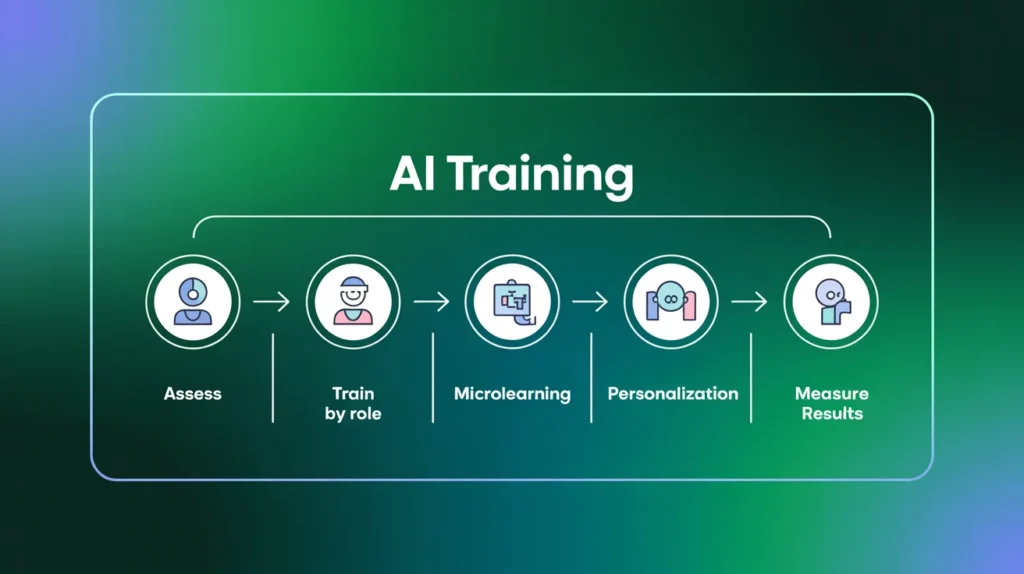
Step 1: Assess Your Current Situation
Look at your team’s daily tasks. Which ones are repetitive? Which take too much time? These are perfect candidates for AI automation.
Start with areas like:
- Email writing and responses
- Data analysis and reporting
- Document creation
- Customer support
- Meeting summaries
Step 2: Choose the Right Training Approach
Don’t try to train everyone on everything at once. Focus on specific skills that matter for each role.
For Sales Teams:
- AI-powered customer research
- Automated follow-up sequences
- Lead scoring and prioritization
For Marketing Teams:
- Content creation with AI tools
- Data analysis for campaign optimization
- Personalized customer messaging
For Operations Teams:
- Process automation
- Predictive maintenance
- Supply chain optimization
Step 3: Use Microlearning
Research shows that lessons under 10 minutes work best. Employees can fit short training sessions into busy schedules.
Break your AI training into small chunks:
- 5-minute tool introductions
- 10-minute hands-on practice
- 15-minute problem-solving sessions
Step 4: Make It Personal
One-size-fits-all training doesn’t work. AI can actually help you personalize the training experience.
Modern training platforms analyze each employee’s:
- Current skill level
- Learning style
- Job requirements
- Career goals
Then they create custom learning paths for each person.
Step 5: Measure Results
Track specific metrics to see if your training works:
Productivity Metrics:
- Time saved per task
- Tasks completed per day
- Error rates
- Customer response times
Employee Metrics:
- Training completion rates
- Tool adoption rates
- Employee satisfaction scores
- Retention rates
Business Metrics:
- Revenue per employee
- Cost savings
- Customer satisfaction
- Time to market for new products
Common AI Training Mistakes to Avoid
Mistake 1: Training Without Context
Don’t just teach people how to use AI tools. Explain why they should use them. Connect training to their daily work challenges.
Mistake 2: Rushing the Process
Give employees time to learn and practice. Expect a learning curve. Most companies need 12-18 months to see full results from AI training.
Mistake 3: Ignoring Feedback
Ask employees how the training is going. What’s working? What’s confusing? Use their feedback to improve the program.
Mistake 4: Focusing Only on Tech Skills
AI training isn’t just about technical skills. Include:
- Critical thinking
- Problem-solving
- Collaboration with AI tools
- Ethics and responsible AI use
Building an AI-Ready Culture
Training is just the start. You need to create a culture where people feel comfortable experimenting with AI.
Encourage Experimentation
- Give employees time to explore AI tools
- Share success stories from other team members
- Celebrate small wins and learning moments
Address Fears Honestly
- Some employees worry about job security
- Be transparent about how AI will change roles
- Focus on how AI makes work more interesting, not just more efficient
Lead by Example
- Managers and executives should use AI tools too
- Share your own learning experiences
- Show that everyone is learning together
Creating Your AI Training Roadmap
Here’s a practical timeline for rolling out AI training:
Month 1-2: Foundation
- Assess current skills and needs
- Choose initial AI tools
- Train key champions in each department
Month 3-4: Pilot Programs
- Start with one department or team
- Focus on 2-3 specific use cases
- Gather feedback and measure results
Month 5-6: Expand
- Roll out to more departments
- Add new tools and skills
- Refine training based on pilot results
Month 7-12: Scale
- Company-wide implementation
- Advanced training for power users
- Continuous improvement based on data
The Cost of Doing Nothing
While you’re deciding whether to invest in AI training, your competitors are moving ahead.
Companies without AI training face:
- Slower decision-making compared to AI-enabled competitors
- Higher operational costs from manual processes
- Lower employee satisfaction as workers feel left behind
- Difficulty attracting talent who expect modern tools
The gap between AI-trained and non-trained workforces grows every month.
ROI Calculator for AI Training
Here’s a simple way to estimate your return on investment:
For a 100-person company:
- Average AI tool cost: $20 per person per month = $24,000 annually
- Training and setup costs: $50,000 first year
- Total investment: $74,000
Potential savings from 10% productivity improvement:
- Average employee cost: $60,000 per year
- 10% productivity gain: $6,000 per employee
- Total value: $600,000 annually
Net ROI: 700% in the first year
Even with conservative estimates, most companies see positive ROI within 12 months.
Getting Started Today
You don’t need to wait for a perfect plan. Start small and build momentum.
Week 1:
- Survey your team about current pain points
- Identify 3-5 repetitive tasks that AI could help with
- Research AI tools for those specific tasks
Week 2:
- Test 2-3 AI tools with a small group
- Measure time savings and quality improvements
- Gather feedback from early users
Week 3:
- Create simple training materials for the best tools
- Train department champions
- Set up measurement systems
Week 4:
- Begin regular training sessions
- Share early wins with the whole company
- Plan expansion to other departments
The Future is Now
AI training isn’t about preparing for the future. It’s about succeeding today.
Your competitors are already using AI to:
- Respond to customers faster
- Create better products
- Make smarter decisions
- Reduce costs
Every day you wait, they get further ahead.
But here’s the good news. You can catch up quickly. Most AI tools are easy to learn. Your employees are probably already using some AI in their personal lives.
The key is making AI training a priority. Not someday. Today.
Taking Action
AI training gives your business three competitive advantages:
- Speed – Your team makes decisions faster with AI assistance
- Quality – AI helps reduce errors and improve output
- Scale – You can handle more work without hiring more people
Companies that master these advantages win in their markets.
The question isn’t whether you should train your employees on AI. The question is how fast you can start. If you’re ready to give your business the competitive edge that comes from proper AI training, let’s talk about creating a custom AI transformation strategy for your team. The companies that act now will be the ones leading their industries tomorrow.
Comment:
"oppna ett binance-konto
December 16, 2025 at 6:43 amYour point of view caught my eye and was very interesting. Thanks. I have a question for you. https://accounts.binance.com/register-person?ref=IXBIAFVY