

AI Skills Gap in Malaysia, A Crisis 2026 (And the 5-Step Solution Your Competitors Are Already Using)
Malaysian companies are desperate for AI talent. The AI skills gap in Malaysia isn’t just inconvenient anymore. It’s an existential threat.
81% of Malaysian employers can’t find people with the AI skills they need. That’s 4 out of 5 companies.
Think about that. Your competitors are hunting for the same scarce talent. And losing.
Here’s the reality nobody wants to admit: AI Skills Gap in Malaysia won’t be solved by hiring. There aren’t enough qualified people. The math doesn’t work.
Budget 2026 allocated RM600 million specifically to address AI Skills Gap in Malaysia. The government knows this is critical. Companies that act now will dominate. Companies that wait will struggle to survive.
This is how you bridge the AI skills gap Malaysia faces—before your competitors do.
The Shocking Numbers Behind AI Skills Gap in Malaysia
Let’s start with facts. The AI skills gap in Malaysia is worse than most people realize.
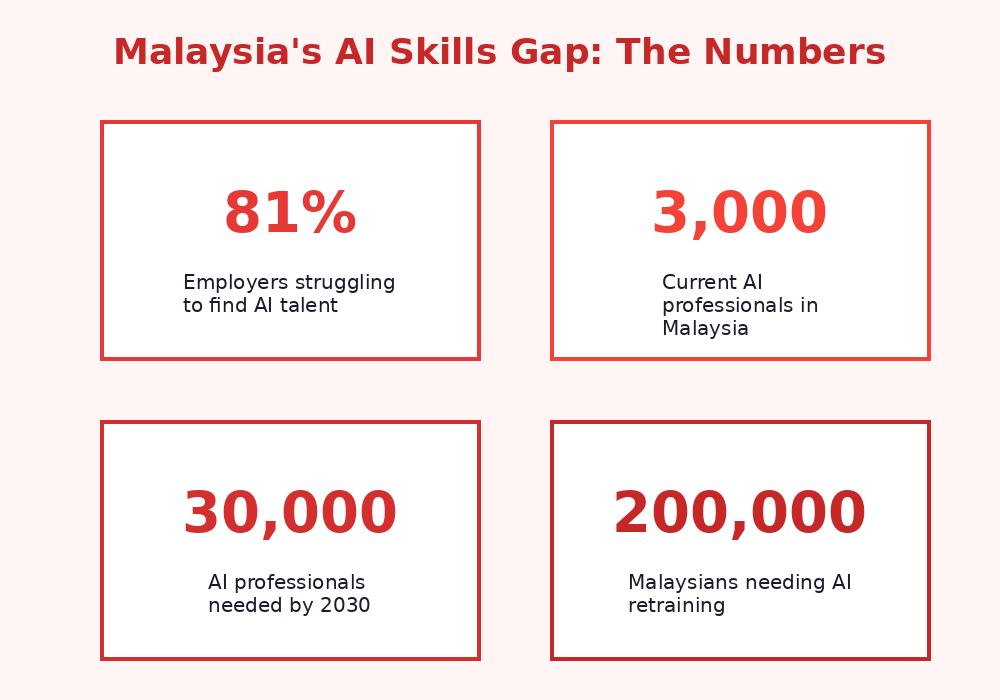
Current state of AI skills in Malaysia:
- Only 3,000 AI professionals in Malaysia right now
- Need 30,000 AI professionals by 2030
- That’s a 27,000-person gap in 4 years
- 81% of Malaysian employers report difficulty finding AI talent
- 68% of businesses can’t hire skilled workers for AI roles
- 200,000 Malaysians need AI retraining in next 3 years
According to the World Bank, AI Skills Gap in Malaysia represents one of the biggest workforce challenges facing the nation. The World Bank’s Malaysia Economic Monitor explicitly identifies AI skills as critical for economic competitiveness.
This AI skills gap Malaysia is experiencing impacts every sector. Manufacturing can’t automate. Services can’t scale. Retail can’t compete with AI-powered international brands. Finance loses to fintech. Healthcare falls behind on AI diagnostics.
The pattern is clear: companies with AI-skilled teams pull ahead. Companies without AI skills fall behind. Fast.
Why AI Skills Gap in Malaysia Is Getting Worse, Not Better
You’d think market forces would solve the AI skills gap. Higher demand = higher supply, right?
Wrong. Three factors make AI Skills Gap in Malaysia uniquely difficult:
1. Training can’t keep pace with demand
Malaysian universities produce about 500 AI-qualified graduates yearly. We need 7,500 new AI professionals per year to close the gap by 2030. That’s a 15x shortfall.
Traditional education isn’t moving fast enough to solve AI Skills Gap in Malaysia.
2. International brain drain
Malaysian AI talent gets recruited internationally. Singapore, Australia, US tech companies pay 2-3x Malaysian salaries. The few AI-skilled Malaysians we do produce often leave.
The AI skills gap in Malaysia actually worsens as talent exits faster than we train replacements.
3. AI evolves faster than curricula
By the time universities update AI programs, the technology has moved on. ChatGPT disrupted everything in 2023. Claude, Gemini, and other models evolved rapidly. Traditional education can’t keep up.
This means relying on formal education won’t bridge the AI skills gap Malaysia faces.
What Happens If You Don’t Address Your AI Skills Gap
Some companies think: “We’ll deal with the AI skills gap later. It’s not urgent.”
That’s dangerous thinking. Here’s the actual timeline if you don’t act on AI Skills Gap in Malaysia:
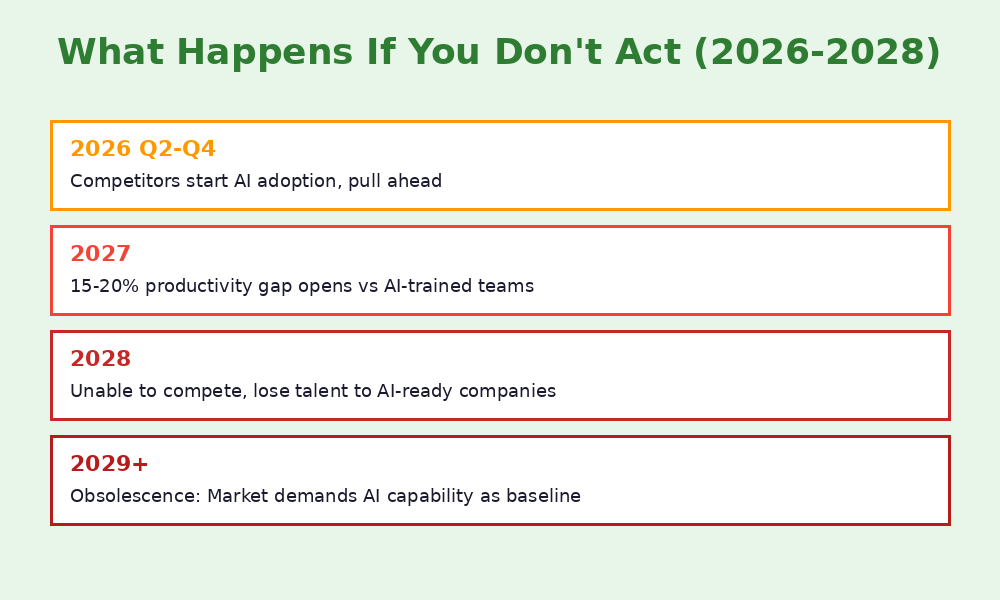
2026 Q2-Q4 (Right Now): Competitors start training their teams on AI. They begin seeing 20-40% productivity gains. You’re still “planning” and fall behind.
2027: The productivity gap opens to 40-60%. Competitors serve more clients with same headcount. They win proposals because they deliver faster. Your costs rise while their costs drop.
2028: You start losing talented employees. They want to work somewhere that invests in their AI skills. The best people leave for companies that solved their AI skills gap. You’re left with people who resist change.
2029+: Clients expect AI-powered delivery. It’s baseline now. You’re seen as outdated. New business dries up. You’re fighting for survival while competitors who addressed AI Skills Gap in Malaysia are thriving.
This isn’t speculation. This exact pattern happened with digital transformation, internet adoption, and mobile computing. Companies that moved first dominated. Laggards died.
The AI skills gap in Malaysia will follow the same pattern.
The 5-Step Framework to Bridge Your AI Skills Gap
Hiring won’t solve AI Skills Gap in Malaysia. But training can.
Here’s the proven framework Malaysian companies are using right now to close their AI skills gap:
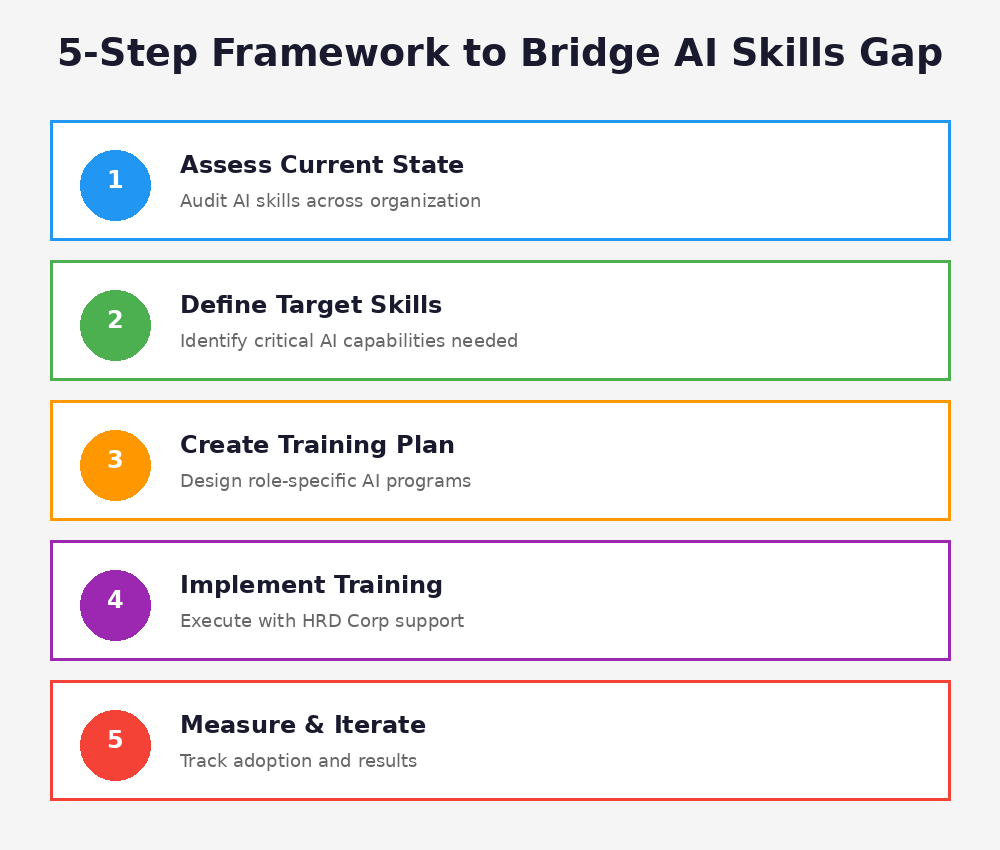
Step 1: Assess Your Current AI Skills Gap
You can’t fix what you don’t measure. Start by auditing AI skills across your organization.
Survey your teams:
- Who currently uses AI tools? (ChatGPT, Claude, automation platforms)
- What AI skills exist? (Prompt engineering, data analysis, automation design)
- Where are the biggest gaps? (By department, role, seniority)
- What business problems could AI solve if we had the skills?
Most Malaysian companies discover their AI skills gap is wider than expected. Even companies that “use AI” often find only 10-20% of employees have meaningful AI capabilities.
This assessment reveals your specific AI skills gap, not industry averages.
Step 2: Define Target AI Skills
Not everyone needs deep AI expertise. Define what AI skills each role actually needs.
For executives: Strategic AI thinking, ROI evaluation, vendor selection
For managers: AI team management, process automation, performance measurement
For individual contributors: Tool proficiency (ChatGPT, industry-specific AI), prompt engineering, workflow integration
The goal isn’t turning everyone into AI engineers. It’s equipping everyone with the AI skills their role requires. That’s how you practically address the AI skills gap Malaysia faces at your company.
Step 3: Create Your AI Skills Training Plan
Now design training that closes your specific AI skills gap.
Effective training for AI Skills Gap in Malaysia includes:
- Practical focus: Real tools, real scenarios, immediate application
- Role-specific content: AI for HR, AI for sales, AI for finance—not generic
- Malaysian context: Local examples, RM calculations, PDPA compliance
- HRD Corp certified: Get full reimbursement (training costs RM0)
- Ongoing support: Questions answered, adoption tracked, results measured
The best AI training for Malaysian companies focuses on business outcomes, not technical theory.
Step 4: Implement with HRD Corp Support
Here’s the part that makes AI Skills Gap in Malaysia easier to solve: government funding.
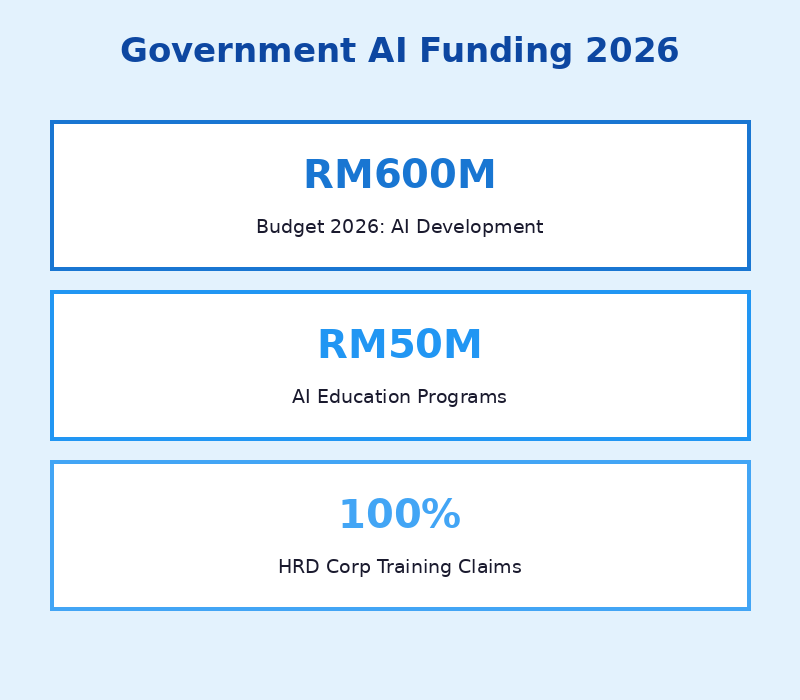
Budget 2026 specifically allocates funds to address AI Skills Gap in Malaysia:
- RM600 million for AI research and development
- RM50 million specifically for AI education programs
- 100% HRD Corp reimbursement for approved AI training
This means solving your AI skills gap can cost RM0 if you use HRD Corp certified training. The government will reimburse your training costs.
Most Malaysian companies don’t realize this support exists. You’re literally leaving money on the table by not claiming it.
Step 5: Measure Results and Iterate
Training alone doesn’t solve AI Skills Gap in Malaysia. Adoption and application do.
Track these metrics:
- Usage rate: What % of trained employees actively use AI tools weekly?
- Time savings: How many hours per week does AI save per employee?
- Quality improvements: Are deliverables better? Clients happier?
- Revenue impact: Can you serve more clients with same headcount?
- Retention: Are skilled employees staying because you invested in them?
Companies that close AI Skills Gap in Malaysia successfully don’t just train once. They measure, refine, and train continuously as AI evolves.
Real Results from Malaysian Companies Addressing the AI Skills Gap
Theory is nice. Results matter.
Here’s what happens when Malaysian companies systematically address their AI skills gap:
Professional services firm (80 employees): Trained entire team on AI tools over 3 months. Closed their internal AI skills gap completely. Results: 35% productivity increase, served 25 more clients yearly with no new hires, RM420,000 additional revenue.
Manufacturing company (200 employees): Focused AI skills training on planning, quality control, and operations teams. Addressed the specific AI skills gap in their production processes. Results: 28% reduction in planning time, 40% faster quality issue detection, RM280,000 annual savings.
Retail business (50 employees): Closed AI skills gap in marketing and customer service departments through focused training. Results: 10x increase in content production, 50% faster customer response times, 15% revenue growth attributed to better marketing.
These aren’t special companies. They just addressed AI Skills Gap in Malaysia systematically instead of hoping it would solve itself.
Their secret? They invested in practical ROI-focused AI training rather than theoretical courses.
Why Traditional Hiring Won’t Solve Your AI Skills Gap
Some companies think: “We’ll just hire AI experts to solve our AI skills gap.”
That strategy fails for Malaysian businesses. Here’s why the AI skills gap can’t be solved through hiring:
Talent doesn’t exist in Malaysia at scale: Only 3,000 AI professionals total. Your competitors want them too. You’ll lose bidding wars to bigger companies or international offers.
Salaries are prohibitive: Malaysian AI specialists command RM150,000-250,000 yearly. Senior roles exceed RM300,000. Can you afford 5-10 at those rates?
They don’t understand your business: External AI experts need 6-12 months to understand your specific business context. Training your existing team is faster and more effective.
Knowledge doesn’t spread: Hiring 2-3 AI experts doesn’t solve AI Skills Gap in Malaysia across your whole organization. Your other 50-500 employees still lack skills.
Retention is terrible: AI specialists get recruited constantly. They leave for better offers. You’re back at square one.
The only sustainable solution to the AI skills gap Malaysia faces is training your existing teams.
Common Mistakes Companies Make Addressing AI Skills Gaps
Waiting for the perfect moment: There’s no perfect time. The AI skills gap in Malaysia is widening daily. Every month you wait, competitors pull further ahead.
Training only IT department: AI isn’t an IT problem. It’s a business capability problem. The AI skills gap exists in marketing, sales, HR, finance, operations. Train everyone.
Choosing academic courses over practical training: Universities teach AI theory. You need people who can use ChatGPT for proposals, Claude for analysis, AI tools for automation. Practical skills close AI Skills Gap in Malaysia. Theory doesn’t.
Not using HRD Corp funding: Literally free money. Don’t pay full price for AI skills training when the government will reimburse you.
Training once and forgetting: AI evolves fast. Solving AI Skills Gap in Malaysia requires continuous learning, not one-off training.
No follow-through: Training without implementation support fails. Teams need ongoing guidance as they apply AI skills to real work.
The Competitive Advantage of Solving AI Skills Gap in Malaysia First
Companies that address the AI skills gap early create compounding advantages:
Market positioning: “We’re the AI-powered option” differentiates you immediately. Clients notice. Media covers you. Talent wants to join you.
Productivity moat: Every quarter you operate with AI-skilled teams while competitors don’t, you pull further ahead. They can never catch up to your accumulated advantage.
Talent attraction: Best people want to work where they’ll learn cutting-edge skills. Solving your AI skills gap makes you a talent magnet. Your competitors face worse AI skills gaps as their people leave for you.
Client preference: Given equal price, clients choose the company that delivers faster and better. AI-skilled teams do both.
Survival: By 2028, AI capability won’t be optional. It’ll be baseline. Companies that solved AI Skills Gap in Malaysia early survive. Laggards don’t.
The AI skills gap in Malaysia creates a rare opportunity. For 2-3 years, simply having AI-skilled teams makes you exceptional. That window closes as more companies address their gaps.
First movers win disproportionately.
Your Next Steps to Close AI Skills Gap in Malaysia
You understand the problem. You know the stakes. Now what?
This week: Assess your current AI skills gap. Survey teams. Identify biggest gaps.
This month: Define target AI skills per role. Create training plan. Research HRD Corp certified providers.
This quarter: Execute training. Get HRD Corp reimbursement. Measure initial results.
This year: Build AI-skilled organization that dominates your market while competitors struggle with their AI skills gap.
AI Skills Gap in Malaysia won’t solve itself. It’ll get worse as AI advances faster than training programs adapt.
But individual companies CAN solve their specific AI skills gap. Through systematic, practical training focused on business outcomes.
The companies solving AI Skills Gap in Malaysia today are the winners of tomorrow.
Ready to eliminate your AI skills gap and build an AI-ready team?
I’m David Hooi, HRD Corp Accredited Trainer with 20+ years corporate experience. I’ve helped Malaysian companies close their AI skills gaps through practical, business-focused training.
Why companies choose D Action Consultancy to solve their AI skills gap:
- ✓ HRD Corp certified – Training costs 100% reimbursed
- ✓ Practical focus – Real tools, immediate application, measurable results
- ✓ Malaysian context – Local examples, RM calculations, PDPA compliance
- ✓ Proven track record – 4,000+ professionals trained, 94% satisfaction
- ✓ Role-specific programs – Not generic, tailored to your departments
- ✓ Ongoing support – 90-day post-training follow-up included
Companies like TNB, Great Eastern, RHB, UOB Kay Hian, and Nu Skin trust us to close their AI skills gaps.
Free consultation includes:
- Assessment of your specific AI skills gap
- Customized training plan for your company
- HRD Corp claiming strategy (get RM0 net cost)
- Expected ROI projection with timeline
- Implementation roadmap
Book Your Free AI Skills Gap Assessment – Let’s close your AI skills gap before your competitors do.
Don’t let the crisis of AI Skills Gap in Malaysia become your company’s extinction event. Act now.