

Most business leaders feel lost when it comes to AI. You hear about it everywhere. Your competitors are using it. Your team asks about it. But where do you even start?
Here’s the truth: You don’t need to become a data scientist to lead your company through AI transformation. You just need to understand the basics and know how to make smart decisions.
This guide breaks down everything you need to know about AI for business in simple terms. No jargon. No technical nonsense. Just practical information you can use right away.
What AI Really Means for Your Business
AI isn’t some distant future technology anymore. It’s here. It’s working. And it’s changing how businesses operate.
The numbers tell the story:
- 78% of companies already use AI in at least one business function
- 91% of small and mid-sized companies using AI report higher income
- 74% of executives see positive returns within the first year
But here’s what most people miss: AI isn’t about replacing humans. It’s about making your team more effective.
Think of AI as a really smart assistant that never gets tired, never takes breaks, and can handle boring tasks so your people can focus on what matters most.
The Five Core Areas Every Leader Needs to Understand
1. Machine Learning Basics
Machine learning sounds complicated, but it’s actually simple. It’s just computers learning patterns from data.
Here’s how it works:
- You feed the computer lots of examples
- It finds patterns you might miss
- It uses those patterns to make predictions or decisions
Real example: A retail store uses machine learning to predict which products will sell well next month based on past sales data, weather patterns, and local events.
2. Natural Language Processing (NLP)
This is how computers understand human language. It’s what powers chatbots, email filters, and translation tools.
Business applications:
- Customer service chatbots that actually help customers
- Email systems that sort and prioritize messages
- Tools that analyze customer feedback and reviews
3. Generative AI
This is the newest kid on the block. Tools like ChatGPT that can write, create, and design.
What it’s good for:
- Writing first drafts of emails, reports, and marketing copy
- Creating presentations and visual content
- Brainstorming ideas and solutions
What it’s not good for:
- Making final decisions without human review
- Handling sensitive or confidential information
- Replacing creative thinking (it enhances it)
4. Data Analytics and Insights
AI can look at massive amounts of data and spot trends humans would never see.
This helps with:
- Understanding customer behavior
- Predicting market trends
- Finding operational inefficiencies
- Making better strategic decisions
5. Process Automation
AI can handle repetitive tasks automatically. This frees up your team for more valuable work.
Common examples:
- Invoice processing
- Appointment scheduling
- Inventory management
- Customer data entry
How to Start Your AI Journey
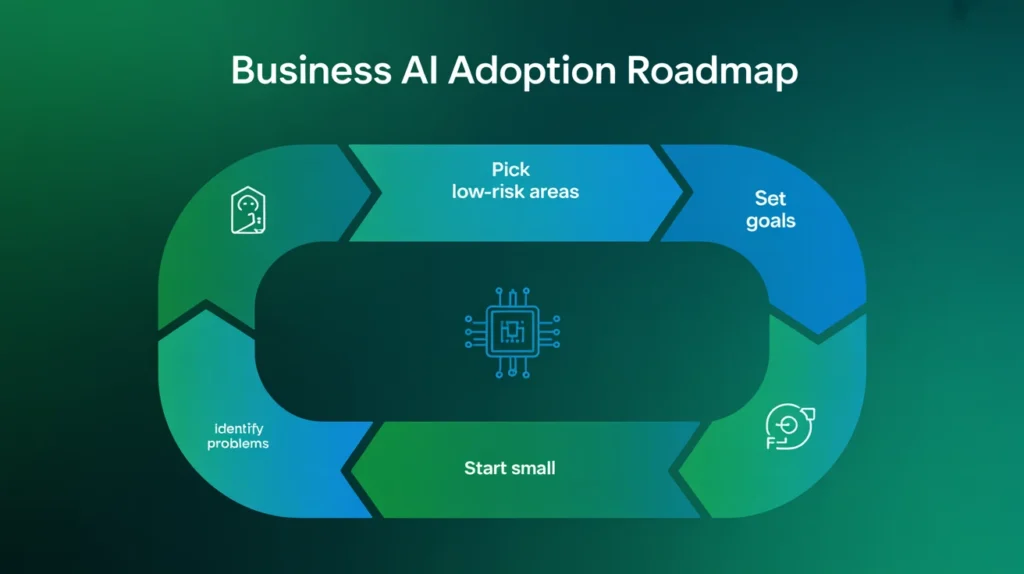
Step 1: Identify Your Biggest Problems
Don’t start with AI. Start with your business challenges.
Ask yourself:
- What tasks take up too much time?
- Where do you make the most mistakes?
- What processes frustrate your customers?
- Which decisions could you make faster with better information?
Step 2: Pick Low-Risk Starting Points
Begin with areas where mistakes won’t hurt your business. Good first projects include:
- Internal document processing
- Basic customer service questions
- Data analysis and reporting
- Content creation for marketing
Step 3: Set Clear Goals
Be specific about what success looks like. Instead of “improve efficiency,” say “reduce invoice processing time by 50%.”
Step 4: Start Small and Test
Run pilot projects before going all-in. This lets you learn what works without risking too much.
The Real Costs and Returns
Let’s talk numbers. Most executives struggle to measure AI returns, but the successful ones follow a pattern.
Investment Areas
Technology costs:
- Software licenses
- Cloud computing resources
- Integration with existing systems
Human costs:
- Training your team
- Hiring AI-savvy talent
- Change management
Time costs:
- Learning curve during implementation
- Data preparation and cleanup
- Process redesign
Expected Returns
Research shows realistic expectations:
- 45% of executives can actually measure their AI ROI
- About one-third see returns under 5%
- Another quarter see returns between 5-10%
- The top performers see 20% or higher returns
The key difference? High-performing companies focus on business value, not just technology.
Managing Change and Your Team
Here’s where most AI projects fail: They ignore the human side.
Address Common Fears
Your team will worry about:
- Job security
- Learning new skills
- Making mistakes with new technology
- Being replaced by machines
How to handle this:
- Be honest about changes coming
- Invest in training and reskilling
- Show how AI will make their jobs better, not eliminate them
- Start with tools that help rather than replace
Build AI Literacy
Everyone on your team needs basic AI understanding. This doesn’t mean coding classes. It means:
- Understanding what AI can and can’t do
- Knowing how to work with AI tools
- Recognizing when AI output needs human review
- Being comfortable asking questions about AI decisions
Create Psychological Safety
People need to feel safe experimenting with AI. Encourage questions. Celebrate learning from mistakes. Make it clear that not knowing something about AI is okay.
Industry-Specific Applications
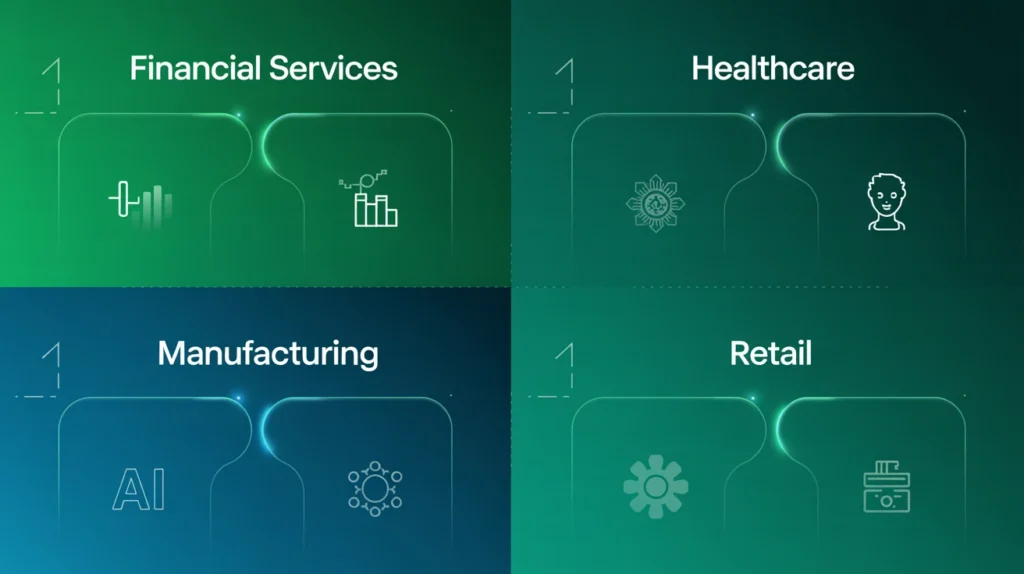
AI works differently across industries. Here’s what’s working now:
Financial Services
- Investment analysis and modeling
- Customer service automation
- Fraud detection and prevention
- Risk assessment
Healthcare
- Diagnostic support
- Patient monitoring
- Administrative task automation
- Treatment recommendation systems
Manufacturing
- Predictive maintenance
- Quality control
- Supply chain optimization
- Production planning
Retail and E-commerce
- Personalized product recommendations
- Inventory management
- Customer behavior analysis
- Dynamic pricing
Ethics and Governance You Can’t Ignore
AI isn’t just a technology decision. It’s a business risk and reputation issue.
Key Ethical Concerns
Bias and fairness: AI systems can accidentally discriminate against certain groups if not carefully designed.
Transparency: Customers and employees should understand when and how you’re using AI.
Privacy: AI often requires lots of data. Make sure you’re protecting customer information.
Accountability: When AI makes a mistake, who’s responsible?
Building Governance
Start with these basics:
- Create clear policies for AI use
- Train people on ethical AI practices
- Set up regular reviews of AI systems
- Have a plan for when things go wrong
Common Mistakes to Avoid
Mistake 1: Chasing Shiny Objects
Don’t implement AI just because it’s trendy. Focus on solving real business problems.
Mistake 2: Going Too Big Too Fast
Start small. Learn. Then scale. Don’t try to transform everything at once.
Mistake 3: Ignoring Data Quality
AI is only as good as the data you feed it. Clean, accurate data is essential.
Mistake 4: Underestimating Change Management
Technology is easy. People are hard. Spend time and money on helping your team adapt.
Mistake 5: Not Measuring Results
If you can’t measure it, you can’t improve it. Set clear metrics from day one.
What’s Coming Next
AI is moving fast. Here’s what to watch for in the next two years:
AI Agents
Think of these as AI assistants that can complete entire tasks, not just single actions. They’re already handling customer service, sales support, and technical tasks in many companies.
Better Integration
AI tools will work better with your existing software. Less switching between apps. More seamless workflows.
Industry-Specific Solutions
Generic AI tools are giving way to specialized solutions built for specific industries and use cases.
Stronger Governance
Governments are creating new rules for AI use. Stay informed about regulations that might affect your business.
Your Next Steps
Ready to get started? Here’s your action plan:
- Assess your current state: Where could AI help your business most?
- Educate your team: Start with AI literacy training for key leaders
- Pick a pilot project: Choose something low-risk but high-visibility
- Set up governance: Create basic policies and guidelines
- Measure and learn: Track results and adjust your approach
Remember, you don’t need to become an AI expert overnight. You just need to be smart about how you approach it.
The companies winning with AI aren’t the ones with the fanciest technology. They’re the ones that understand their business problems, choose the right solutions, and manage change well.
Conclusion
AI isn’t going away. It’s becoming as essential as email or mobile phones once were. But you don’t need to rush into it blindly.
Start with your business needs. Focus on your people. Be honest about challenges. And remember that the goal isn’t to implement AI. It’s to make your business more effective.
The leaders who succeed with AI will be those who balance innovation with practical thinking. They’ll be the ones who remember that technology serves people, not the other way around.
If you’re ready to explore how AI can transform your business in Southeast Asia, our team specializes in helping leaders navigate this journey with practical, proven strategies.
Get in touch with us to discuss your AI transformation roadmap and discover how to turn AI complexity into business advantage.
AI for Business – AI 101 Fundamentals for Managers & Leaders
Most business leaders feel lost when it comes to AI. You hear about it everywhere. Your competitors are using it. Your team asks about it. But where do you even start?
Here’s the truth: You don’t need to become a data scientist to lead your company through AI transformation. You just need to understand the basics and know how to make smart decisions.
This guide breaks down everything you need to know about AI for business in simple terms. No jargon. No technical nonsense. Just practical information you can use right away.
What AI Really Means for Your Business
AI isn’t some distant future technology anymore. It’s here. It’s working. And it’s changing how businesses operate.
The numbers tell the story:
- 78% of companies already use AI in at least one business function
- 91% of small and mid-sized companies using AI report higher income
- 74% of executives see positive returns within the first year
But here’s what most people miss: AI isn’t about replacing humans. It’s about making your team more effective.
Think of AI as a really smart assistant that never gets tired, never takes breaks, and can handle boring tasks so your people can focus on what matters most.
The Five Core Areas Every Leader Needs to Understand
1. Machine Learning Basics
Machine learning sounds complicated, but it’s actually simple. It’s just computers learning patterns from data.
Here’s how it works:
- You feed the computer lots of examples
- It finds patterns you might miss
- It uses those patterns to make predictions or decisions
Real example: A retail store uses machine learning to predict which products will sell well next month based on past sales data, weather patterns, and local events.
2. Natural Language Processing (NLP)
This is how computers understand human language. It’s what powers chatbots, email filters, and translation tools.
Business applications:
- Customer service chatbots that actually help customers
- Email systems that sort and prioritize messages
- Tools that analyze customer feedback and reviews
3. Generative AI
This is the newest kid on the block. Tools like ChatGPT that can write, create, and design.
What it’s good for:
- Writing first drafts of emails, reports, and marketing copy
- Creating presentations and visual content
- Brainstorming ideas and solutions
What it’s not good for:
- Making final decisions without human review
- Handling sensitive or confidential information
- Replacing creative thinking (it enhances it)
4. Data Analytics and Insights
AI can look at massive amounts of data and spot trends humans would never see.
This helps with:
- Understanding customer behavior
- Predicting market trends
- Finding operational inefficiencies
- Making better strategic decisions
5. Process Automation
AI can handle repetitive tasks automatically. This frees up your team for more valuable work.
Common examples:
- Invoice processing
- Appointment scheduling
- Inventory management
- Customer data entry
How to Start Your AI Journey
Step 1: Identify Your Biggest Problems
Don’t start with AI. Start with your business challenges.
Ask yourself:
- What tasks take up too much time?
- Where do you make the most mistakes?
- What processes frustrate your customers?
- Which decisions could you make faster with better information?
Step 2: Pick Low-Risk Starting Points
Begin with areas where mistakes won’t hurt your business. Good first projects include:
- Internal document processing
- Basic customer service questions
- Data analysis and reporting
- Content creation for marketing
Step 3: Set Clear Goals
Be specific about what success looks like. Instead of “improve efficiency,” say “reduce invoice processing time by 50%.”
Step 4: Start Small and Test
Run pilot projects before going all-in. This lets you learn what works without risking too much.
The Real Costs and Returns
Let’s talk numbers. Most executives struggle to measure AI returns, but the successful ones follow a pattern.
Investment Areas
Technology costs:
- Software licenses
- Cloud computing resources
- Integration with existing systems
Human costs:
- Training your team
- Hiring AI-savvy talent
- Change management
Time costs:
- Learning curve during implementation
- Data preparation and cleanup
- Process redesign
Expected Returns
Research shows realistic expectations:
- 45% of executives can actually measure their AI ROI
- About one-third see returns under 5%
- Another quarter see returns between 5-10%
- The top performers see 20% or higher returns
The key difference? High-performing companies focus on business value, not just technology.
Managing Change and Your Team
Here’s where most AI projects fail: They ignore the human side.
Address Common Fears
Your team will worry about:
- Job security
- Learning new skills
- Making mistakes with new technology
- Being replaced by machines
How to handle this:
- Be honest about changes coming
- Invest in training and reskilling
- Show how AI will make their jobs better, not eliminate them
- Start with tools that help rather than replace
Build AI Literacy
Everyone on your team needs basic AI understanding. This doesn’t mean coding classes. It means:
- Understanding what AI can and can’t do
- Knowing how to work with AI tools
- Recognizing when AI output needs human review
- Being comfortable asking questions about AI decisions
Create Psychological Safety
People need to feel safe experimenting with AI. Encourage questions. Celebrate learning from mistakes. Make it clear that not knowing something about AI is okay.
Industry-Specific Applications
AI works differently across industries. Here’s what’s working now:
Financial Services
- Investment analysis and modeling
- Customer service automation
- Fraud detection and prevention
- Risk assessment
Healthcare
- Diagnostic support
- Patient monitoring
- Administrative task automation
- Treatment recommendation systems
Manufacturing
- Predictive maintenance
- Quality control
- Supply chain optimization
- Production planning
Retail and E-commerce
- Personalized product recommendations
- Inventory management
- Customer behavior analysis
- Dynamic pricing
Ethics and Governance You Can’t Ignore
AI isn’t just a technology decision. It’s a business risk and reputation issue.
Key Ethical Concerns
Bias and fairness: AI systems can accidentally discriminate against certain groups if not carefully designed.
Transparency: Customers and employees should understand when and how you’re using AI.
Privacy: AI often requires lots of data. Make sure you’re protecting customer information.
Accountability: When AI makes a mistake, who’s responsible?
Building Governance
Start with these basics:
- Create clear policies for AI use
- Train people on ethical AI practices
- Set up regular reviews of AI systems
- Have a plan for when things go wrong
Common Mistakes to Avoid
Mistake 1: Chasing Shiny Objects
Don’t implement AI just because it’s trendy. Focus on solving real business problems.
Mistake 2: Going Too Big Too Fast
Start small. Learn. Then scale. Don’t try to transform everything at once.
Mistake 3: Ignoring Data Quality
AI is only as good as the data you feed it. Clean, accurate data is essential.
Mistake 4: Underestimating Change Management
Technology is easy. People are hard. Spend time and money on helping your team adapt.
Mistake 5: Not Measuring Results
If you can’t measure it, you can’t improve it. Set clear metrics from day one.
What’s Coming Next
AI is moving fast. Here’s what to watch for in the next two years:
AI Agents
Think of these as AI assistants that can complete entire tasks, not just single actions. They’re already handling customer service, sales support, and technical tasks in many companies.
Better Integration
AI tools will work better with your existing software. Less switching between apps. More seamless workflows.
Industry-Specific Solutions
Generic AI tools are giving way to specialized solutions built for specific industries and use cases.
Stronger Governance
Governments are creating new rules for AI use. Stay informed about regulations that might affect your business.
Your Next Steps
Ready to get started? Here’s your action plan:
- Assess your current state: Where could AI help your business most?
- Educate your team: Start with AI literacy training for key leaders
- Pick a pilot project: Choose something low-risk but high-visibility
- Set up governance: Create basic policies and guidelines
- Measure and learn: Track results and adjust your approach
Remember, you don’t need to become an AI expert overnight. You just need to be smart about how you approach it.
The companies winning with AI aren’t the ones with the fanciest technology. They’re the ones that understand their business problems, choose the right solutions, and manage change well.
Conclusion
AI isn’t going away. It’s becoming as essential as email or mobile phones once were. But you don’t need to rush into it blindly.
Start with your business needs. Focus on your people. Be honest about challenges. And remember that the goal isn’t to implement AI. It’s to make your business more effective.
The leaders who succeed with AI will be those who balance innovation with practical thinking. They’ll be the ones who remember that technology serves people, not the other way around.
If you’re ready to explore how AI can transform your business in Southeast Asia, our team specializes in helping leaders navigate this journey with practical, proven strategies.
Get in touch with us to discuss your AI transformation roadmap and discover how to turn AI complexity into business advantage.